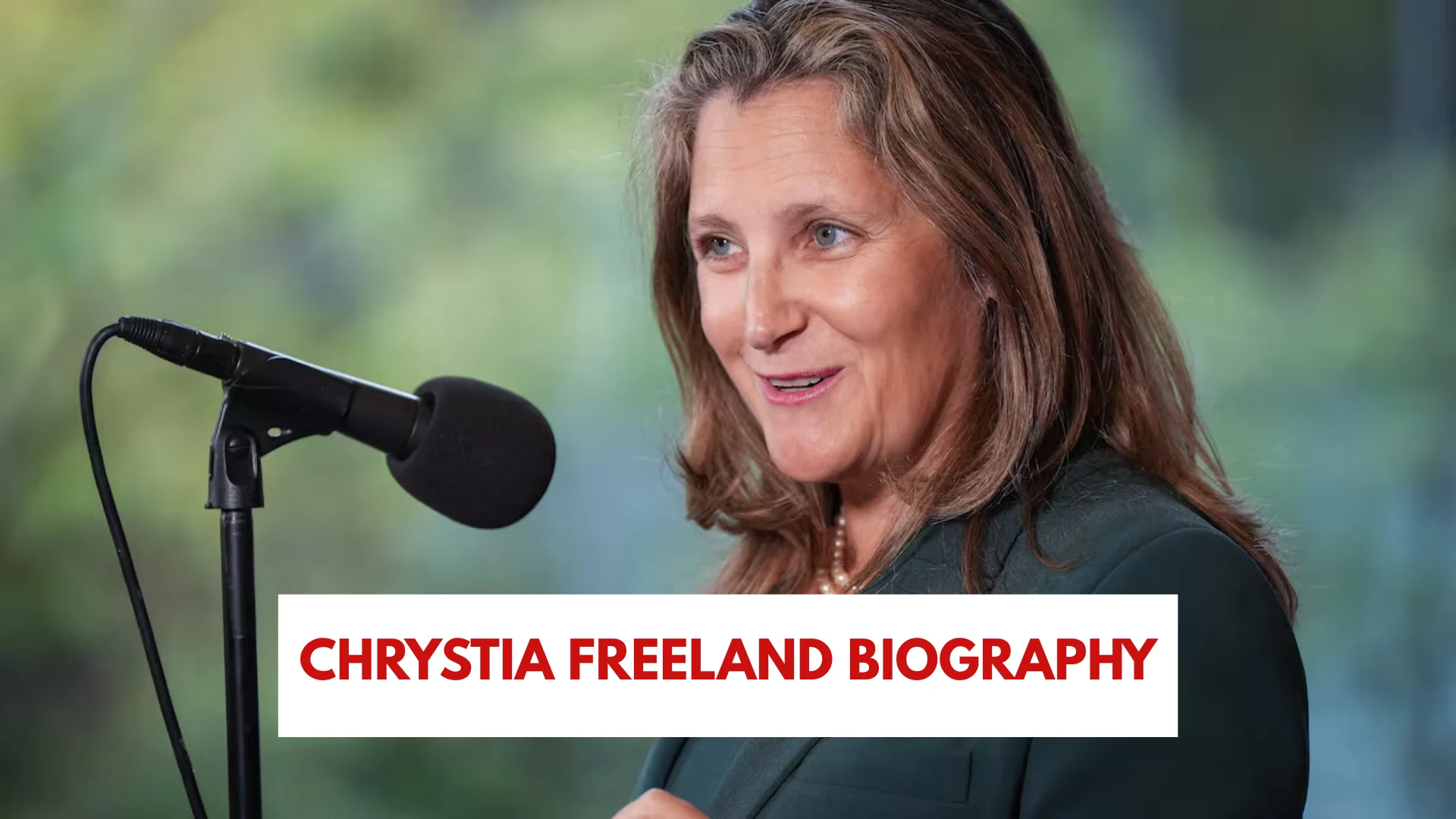
Chrystia Freeland is one of Canada’s most influential political leaders, known for her sharp intellect, global perspective, and strong stance on economic and democratic values.
Over the years, she has built a remarkable career that spans journalism, authorship, and high-level politics. This detailed Chrystia Freeland biography explores her early life, education, journalism career, political achievements, leadership style, and lasting impact on Canadian and global affairs.
Early Life and Family Background
Chrystia Freeland was born on August 2, 1968, in Peace River, Alberta, Canada. She grew up in Edmonton in a family deeply engaged in public affairs, history, and journalism. Her mother, Halyna Chomiak, was a lawyer and an active advocate for Ukrainian culture and independence, while her father, Donald Freeland, was a farmer and lawyer.
Freeland’s Ukrainian heritage played a significant role in shaping her worldview. From an early age, she developed an interest in democracy, freedom, and global politics. These values would later become defining elements of her professional and political life.
Education and Academic Excellence
Chrystia Freeland is widely recognized for her academic achievements. She earned a Bachelor of Arts degree in History and Russian Literature from Harvard University. During her studies, she spent time in Ukraine as an exchange student, where she researched Ukrainian history and politics during the late Soviet era.
As a Rhodes Scholar, Freeland continued her education at the University of Oxford, completing a Master of Studies in Slavonic Studies. Her academic background gave her a deep understanding of Eastern Europe, Russia, and global political systems, which later proved invaluable in both journalism and politics.
Journalism Career
Before entering politics, Chrystia Freeland built an impressive career as an international journalist. She worked for some of the world’s most respected media organizations, including:
- Financial Times
- The Washington Post
- The Economist
- Reuters
- The Globe and Mail
Freeland served as Moscow bureau chief for the Financial Times, where she reported on post-Soviet Russia, oligarchs, and emerging economic systems. Her investigative reporting earned widespread respect for its depth, accuracy, and courage.
Later, she became managing editor of the Financial Times and subsequently editor of Reuters Digital. Her journalism career established her as an expert on global economics, authoritarianism, and wealth inequality.
Books and Thought Leadership
Chrystia Freeland is also a bestselling author. Her most notable books include:
- “Sale of the Century: Russia’s Wild Ride from Communism to Capitalism”
- “Plutocrats: The Rise of the New Global Super-Rich and the Fall of Everyone Else”
“Plutocrats” gained international acclaim for its analysis of wealth concentration and economic inequality. The book positioned Freeland as a leading global thinker on economic justice and globalization, themes that later influenced her political agenda.
Entry into Canadian Politics
Chrystia Freeland entered Canadian politics in 2013 when she ran as a Liberal Party candidate in a by-election for the Toronto Centre riding. She won decisively, marking the beginning of her political career.
Her transition from journalism to politics was widely seen as natural, given her deep understanding of international relations, economics, and public policy.
Key Political Roles and Achievements
Over the years, Chrystia Freeland has held several high-profile positions in the Canadian government, including:
Minister of International Trade
Freeland played a crucial role in renegotiating and defending Canada’s trade agreements. She was a key figure in the negotiations that led to the United States–Mexico–Canada Agreement (USMCA), protecting Canadian economic interests during a challenging period in North American trade relations.
Minister of Foreign Affairs
As Canada’s Foreign Affairs Minister, Freeland was known for her firm stance on human rights, democracy, and multilateral cooperation. She advocated for press freedom, supported democratic movements worldwide, and took strong positions against authoritarian regimes.
Deputy Prime Minister and Minister of Finance
In her role as Deputy Prime Minister and Minister of Finance, Freeland guided Canada through complex economic challenges, including pandemic recovery and global financial uncertainty. Her policies focused on economic resilience, middle-class growth, and fiscal responsibility.
Leadership Style and Political Philosophy
Chrystia Freeland is known for her pragmatic yet principled leadership style. She combines intellectual rigor with political realism, often emphasizing evidence-based policymaking. Her political philosophy centers on:
- Defending democracy and democratic institutions
- Promoting economic fairness and opportunity
- Strengthening alliances and multilateralism
- Supporting the middle class
Her communication style is direct, articulate, and globally informed, making her a respected figure on the international stage.
Global Influence and Recognition
Freeland’s influence extends beyond Canada. She is frequently invited to speak at international forums such as the World Economic Forum and global economic summits. Her insights on globalization, democracy, and economic inequality are widely cited by policymakers and scholars.
She has been recognized as one of the most powerful women in global politics by various international publications.
Personal Life
Despite her demanding career, Chrystia Freeland maintains a relatively private personal life. She is married and has children. She speaks multiple languages, including English, French, Ukrainian, and Russian, reflecting her international background and cultural fluency.
Legacy and Impact
Chrystia Freeland’s legacy lies in her unique blend of journalism, intellectual leadership, and political action. She has shaped key economic and foreign policies in Canada and contributed meaningfully to global discussions on democracy and inequality.
Her career serves as an example of how deep knowledge, integrity, and global awareness can translate into effective political leadership.
FAQs
Who is Chrystia Freeland?
Chrystia Freeland is a Canadian politician, former journalist, and author who has served as Deputy Prime Minister, Minister of Finance, and Minister of Foreign Affairs.
What is Chrystia Freeland known for?
She is known for her work in international trade negotiations, economic policy, journalism, and her strong stance on democracy and human rights.
What books has Chrystia Freeland written?
Her most famous books include “Plutocrats” and “Sale of the Century.”
What is Chrystia Freeland’s educational background?
She studied at Harvard University and Oxford University as a Rhodes Scholar.
Why is Chrystia Freeland influential?
Her influence comes from her leadership in Canadian politics, global economic expertise, and advocacy for democratic values.
Conclusion
This comprehensive Chrystia Freeland biography highlights a life dedicated to journalism, public service, and global leadership. From her academic excellence and groundbreaking journalism to her influential political career, Freeland has left a lasting mark on Canada and the world. Her commitment to democracy, economic fairness, and international cooperation continues to shape modern political discourse and policy.