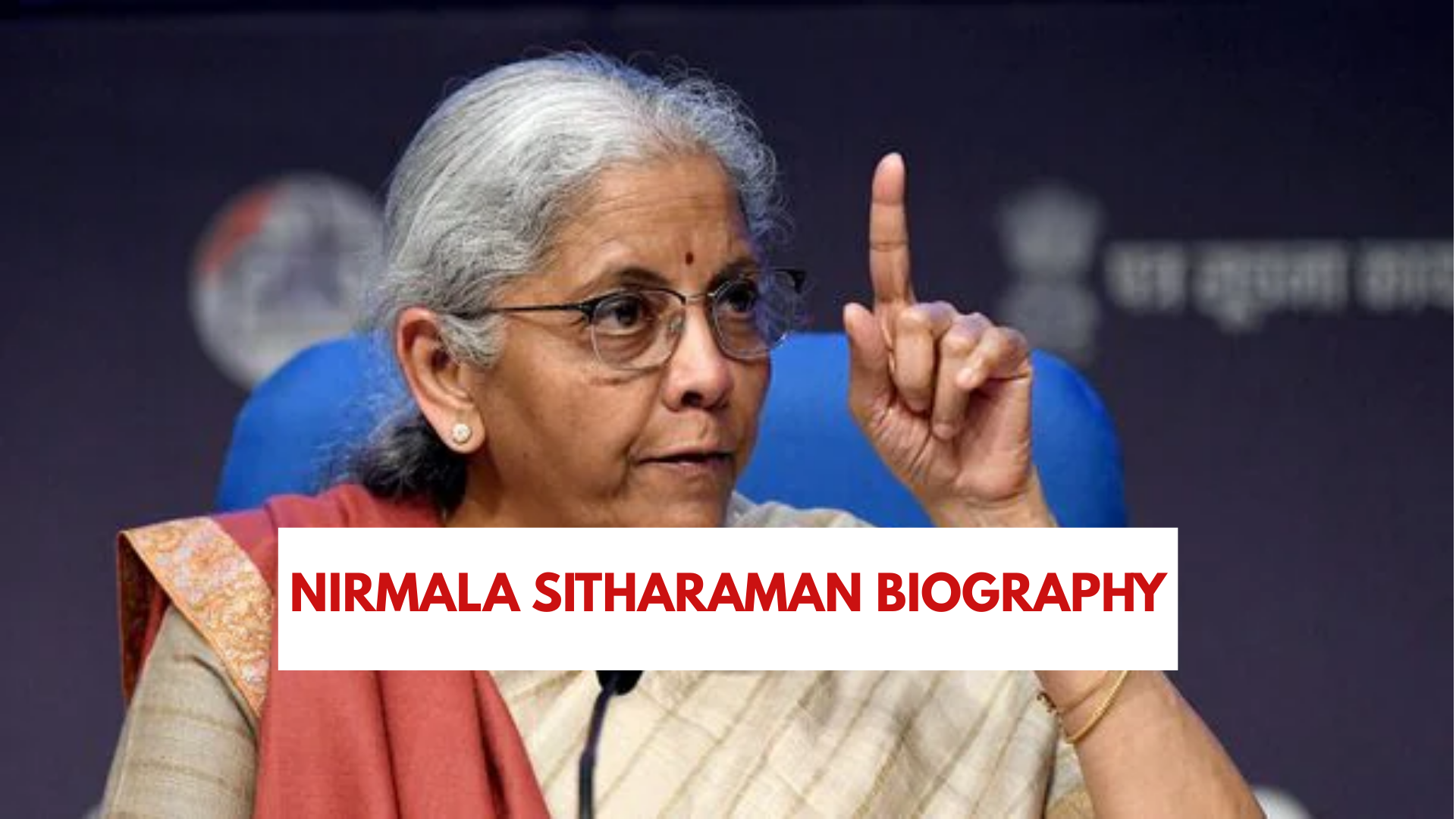
Nirmala Sitharaman is one of India’s most prominent contemporary leaders — an economist-turned-politician who broke gender barriers as the country’s first full-time woman Defence Minister and its first full-time woman Finance Minister.
Early life
Nirmala Sitharaman was born on 18 August 1959 in Madurai, in then Madras State (now Tamil Nadu). She grew up in a family that moved frequently due to her father’s job with the railways, which exposed her to multiple languages and regions across India during childhood. She attended schools in Villupuram, Chennai, and Tiruchirappalli.
Education
Sitharaman completed her B.A. (Economics) from Seethalakshmi Ramaswami College, Tiruchirapalli, and went on to earn an M.A. and an M.Phil. in Economics from Jawaharlal Nehru University (JNU), New Delhi. She later enrolled for doctoral work (on Indo-European trade) but did not complete the Ph.D. before moving to London with her husband. Her academic grounding in economics and international trade has been a throughline across her policy roles.
Career
Before full-time politics, Sitharaman worked as a research associate at the Centre for Development Studies (Thiruvananthapuram) and later held policy-related roles in the UK while accompanying her husband on a scholarship. This combination of Indian development research and overseas exposure sharpened her understanding of trade, fiscal policy, and international negotiations.
Political entry and rise in the BJP
Nirmala Sitharaman joined the Bharatiya Janata Party and gained notice as a strong communicator and policy analyst. She served as the party’s national spokesperson and was later elected to the Rajya Sabha (the upper house of India’s Parliament). Her clear articulation on economic matters led to ministerial responsibilities beginning in 2014.
Ministerial career — timeline & highlights
Commerce & Industry (MoS, Independent Charge) — 2014 to 2017
She began her cabinet career as Minister of State (Independent Charge) for Commerce and Industry, where she supported trade policy measures and the “Make in India” push intended to attract manufacturing investment.
Defence Minister — Sept 2017 to May 2019
In September 2017 she became India’s first full-time woman Defence Minister, overseeing procurement reform, indigenisation of defence manufacturing, and several high-profile strategic decisions during a tense regional security environment. Government press releases and international reporting documented her formal assumption of the charge.
Finance & Corporate Affairs Minister — May 2019 onward
Sitharaman was appointed Finance Minister on 31 May 2019 and has since presented multiple Union Budgets (including a consecutive streak that reached a record number by 2026). Her finance portfolio also included responsibility for corporate affairs. Under her stewardship, the Finance Ministry navigated the COVID-19 crisis, implemented corporate tax reforms, and prioritized infrastructure and digital payments.
Signature budgets & economic priorities
Sitharaman’s budgets and policy choices have emphasized:
- Infrastructure-led growth: boosted capital expenditure to crowd in private investment and create jobs.
- Corporate tax reforms: measures in 2019 aimed at making India more competitive for investment.
- Digital economy & payments: rapid UPI expansion, fintech support, and incentives for digital public infrastructure.
- COVID-19 economic response: she headed the COVID-19 Economic Response Task Force and announced phased relief packages for MSMEs, health spending, and reforms to ease doing business during the pandemic.
- Sectoral initiatives (2025–2026): recent budgets continued to push high-tech manufacturing (e.g., semiconductor mission announcements in Budget 2026), clean energy, and skilling. For example, Budget 2026 announced an India Semiconductor Mission 2.0 to scale domestic capabilities.
Note: Some of these policy areas are ongoing and evolve with new budgetary announcements; the citations above point to official budget documents and credible press coverage for specific measures.
Leadership style & public persona
Sitharaman is widely described as composed, detail-oriented, and data-driven. She often avoids populist soundbites and prefers institutional explanations and policy detail — a style that has attracted both praise (for seriousness) and criticism (for perceived technocratic distance). Her media presence as BJP spokesperson earlier in her career helped polish the public-facing side of her ministerial roles.
Criticisms & controversies
Like any senior politician, Sitharaman’s tenure has seen debate and criticism: concerns about economic growth rates during certain years, questions over implementation speed of reforms, and political disputes around specific statements or policy choices. Importantly, many critiques relate to macroeconomic cycles and global shocks (e.g., pandemic recovery), not just domestic policy decisions. Balanced assessment requires reading both government releases and independent fiscal analysis.
Personal life
She is married to Parakala Prabhakar (a political analyst) and the couple have one son. Despite her high-profile roles, she keeps a relatively private personal life and is known for a disciplined, work-focused routine. Her home and parliamentary addresses are part of official records.
Awards
Sitharaman has been featured in lists of powerful women in global media and has represented India in many international economic forums, reinforcing the country’s fiscal narrative abroad. Her outreach includes meetings with multilateral organisations and sovereign investors to deepen India’s financial engagement.
FAQs
Q1: When was Nirmala Sitharaman born?
A1: She was born on 18 August 1959 in Madurai, Tamil Nadu.
Q2: What is her educational qualification?
A2: B.A. (Economics), M.A. (Economics) and M.Phil. (Economics) from JNU; she also pursued but did not complete a Ph.D. program.
Q3: When did she become India’s Finance Minister?
A3: She was appointed Finance and Corporate Affairs Minister on 31 May 2019 and has presented consecutive budgets since then.
Q4: Was she ever Defence Minister?
A4: Yes — she served as India’s Defence Minister from September 2017 to May 2019, the first woman to hold the full-time post.
Q5: What are her main economic priorities?
A5: Infrastructure spending, digital payments, corporate tax competitiveness, MSME support, and high-tech manufacturing (including semiconductor initiatives).
Conclusion
Nirmala Sitharaman’s career illustrates a path from academic economic training to high-stakes political responsibility. Her legacy is still forming: it will depend on long-term indicators like investment rates, job creation, export competitiveness, and how well structural reforms translate into inclusive growth. For researchers, investors, and readers, the combination of official budget documents, parliamentary records, and credible media analysis will remain the best sources to track her evolving impact.